Which VCE Subjects Scale Up the Most? The 2025 Scaling Report in Plain English
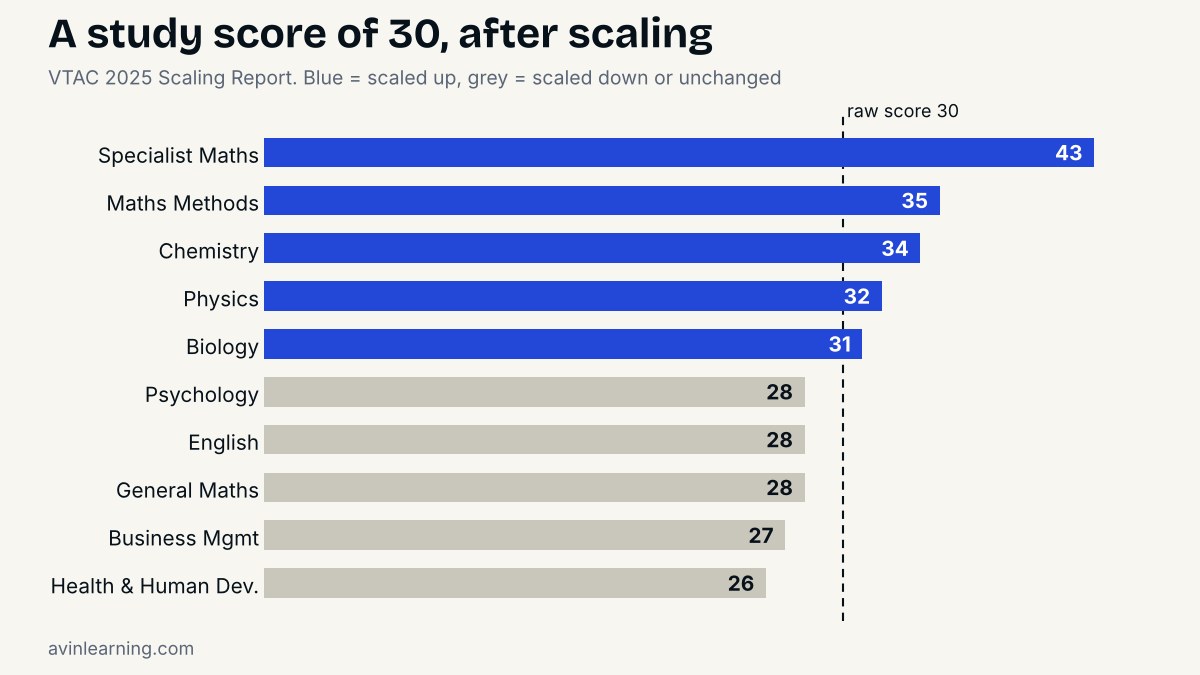
Scaling worries Victorian families more than any other part of the ATAR. Will a 35 in one subject count for less than a 35 in another? Should your child choose subjects that "scale up"? Here is what scaling really does, using the official numbers from VTAC's 2025 report.
What scaling is, in plain English
VTAC puts it in one line: "Scaling adjusts for the fact that it is more difficult to obtain a high VCE study score in some studies than others."
It isn't about one subject being harder than another. It is about who takes it. Think of a running race. Coming 10th in a race full of state champions is a stronger result than coming 10th in a local fun run. Scaling does the same for study scores: a score earned among a very strong group of students is adjusted up, and a score earned among a broader group may be adjusted down.
The 2025 numbers
This table shows what a study score of 30 and of 40 became after scaling in 2025, plus each subject's average scaled score. Higher than the raw score means the subject scaled up.
| Subject | A 30 became | A 40 became | Average scaled score |
|---|---|---|---|
| Latin | 46 | 53 | 45.0 |
| Specialist Mathematics | 43 | 51 | 41.5 |
| French | 41 | 49 | 40.2 |
| Mathematical Methods | 35 | 46 | 34.4 |
| Chemistry | 34 | 44 | 33.6 |
| English Language | 33 | 43 | 32.6 |
| Physics | 32 | 42 | 31.7 |
| Economics | 31 | 42 | 31.2 |
| Literature | 31 | 41 | 31.0 |
| Accounting | 31 | 41 | 30.8 |
| Biology | 31 | 41 | 30.5 |
| Legal Studies | 28 | 40 | 28.6 |
| Psychology | 28 | 39 | 28.4 |
| English | 28 | 39 | 28.2 |
| General Mathematics | 28 | 38 | 27.8 |
| Physical Education | 27 | 38 | 27.6 |
| English as an Additional Language | 27 | 40 | 27.3 |
| Business Management | 27 | 38 | 27.2 |
| Health and Human Development | 26 | 37 | 26.4 |
Source: VTAC 2025 Scaling Report, published 11 December 2025. Scaling is worked out again every year, so next year's numbers will differ a little.
What the table tells you
- Languages and the higher maths subjects scale up the most. The students who choose them tend to be strong across all their subjects, so the competition is tougher.
- The most popular subjects stay close to their raw scores. English and General Mathematics were the two most common subjects in 2025 ATARs, used by 40,285 and 30,189 students. A score in these is worth about what it says.
- A high score in a "low-scaling" subject often beats a low score in a "high-scaling" one. A 40 in General Mathematics became 38. A 25 in Specialist Mathematics became 36. If your child would get 40 in one and 25 in the other, the subject they're better at wins.
Should your child choose subjects for scaling?
No, and VTAC says so clearly: "Choosing a study that you are not very good at, or engaged in, simply because it may be scaled up would be a mistake." Scaling is designed so that "students are neither advantaged nor disadvantaged based on the studies they choose."
A few rules are still worth knowing:
- Up to six subjects count. The best four (including an English subject) count in full, and up to two more add 10% of their scaled score.
- At most two subjects from the same study area count in the top four, and at most three in total.
- Subjects are scaled in the year they're taken, so a Unit 3 and 4 subject done in Year 11 is scaled that year.
What we suggest to families
Start with what your child enjoys, what they're good at, and what their likely university courses require. Then put steady support around the subjects that feel hardest, early in Year 11 rather than in the month before exams.
For the full picture of how scaled scores turn into an ATAR, read our plain-English guide to the ATAR, or see what counts as a good ATAR. If you'd like to talk about subject choices or support for next year, book a call.